A horse spurred with gold
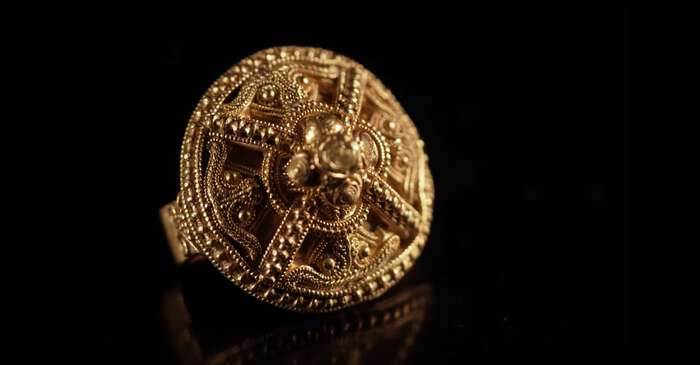
The gold find from Rød in Eastern Norway is a true icon of the Viking Age. It consists of a spur and a dome-shaped strap slide, known as a smygestol. In 1917, 45 years later, a matching tongue-shaped strap end was discovered during farmwork in the same field.
At the Collection of Norwegian Antiquities in Oslo, formerly known as Christiania, the objects were described in sensational terms:
Application of Gold to Items belonging to Riding Equipment; it is also unlikely that any Find has been made in the past, which has been so suitable to illustrate the Viking Age's barbaric Luxury.
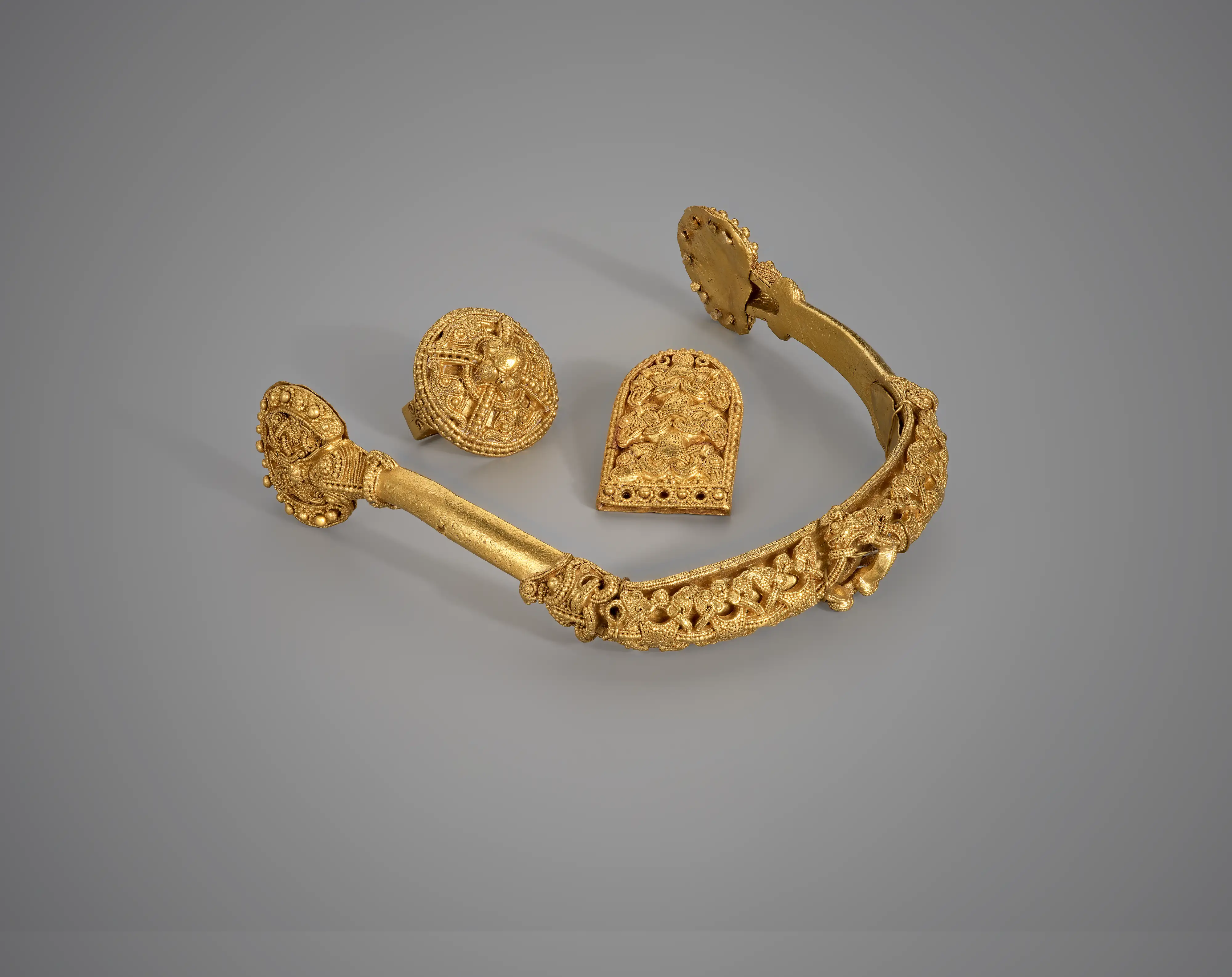
Dating to AD 950-1000, the spur is richly ornamented in a stylistic blend of the Borre and Jellinge animal styles. The finds features curved beaked birds and predatory animals in exquisite filigree work.
The spur is composed of several elements made of 22-carat gold. Its spike, probably of iron or bronze, is missing. Visible wear shows that the spur was both highly valued and well-used.
Such extravagant goldsmithing from the latter part of the Viking Age was propably closely associated with the kings of the Jelling dynasty and The Danelaw.
The gold set is undoubtedly evidence of a royal presence in the old kingdom of Vingulmork, which extended from the inner Oslo Fjord across eastern Norway to Svinesund in western Sweden.
The domed strap slide is decorated with four masks. At its centre are five raised knobs adorned with spirals of gold granules. The central knobs are quite worn.
The objects were first cast in clay moulds. The goldsmith then refined their shape with a small hammer before applying the filigree decoration.
To create the filigree, the goldsmith cut gold wire into suitable lengths and heated it to form tiny gold beads. These were then soldered onto the surface, either individually or in groups.
Beaded wire was produced mechanically using a tool, an organarium or a beading file, by pressing the gold wire into the desired shape.
It is an impressive piece of goldsmithing that is not easily reproduced today!
Worthy of a king
The goldsmith work is related to another exquisite gold find from Hiddensee, west of Rügen in present-day Germany. Jewelry featuring similar ornamentation from other southern Scandinavian regions demonstrates the powerful influence and reach of the Jelling dynasty during the late Viking Age.
The gold set must have belonged to an important person, propably with strong ties to the Danes royal family. Was the set part of an exclusive gift to a local petty king and ally who was subject to the Jellinge king? From the Middle Ages we know of both gilded spurs and spurs in pure gold as symbols for the king, his knights and the aristocracy.
Riding gear like this always come in pairs. The second gold set has never been found. And we are missing a small golden buckle for it to be a complete set.
How did it end up in the ground? Was it a small treasure, hidden away for safekeeping, or perhaps an offering to the gods? We will propably never know. Yet it is tempting to imagine the spur strap snapping as an unfortunate rider galloped across the fields of Rød Farm more than a thousand years ago.