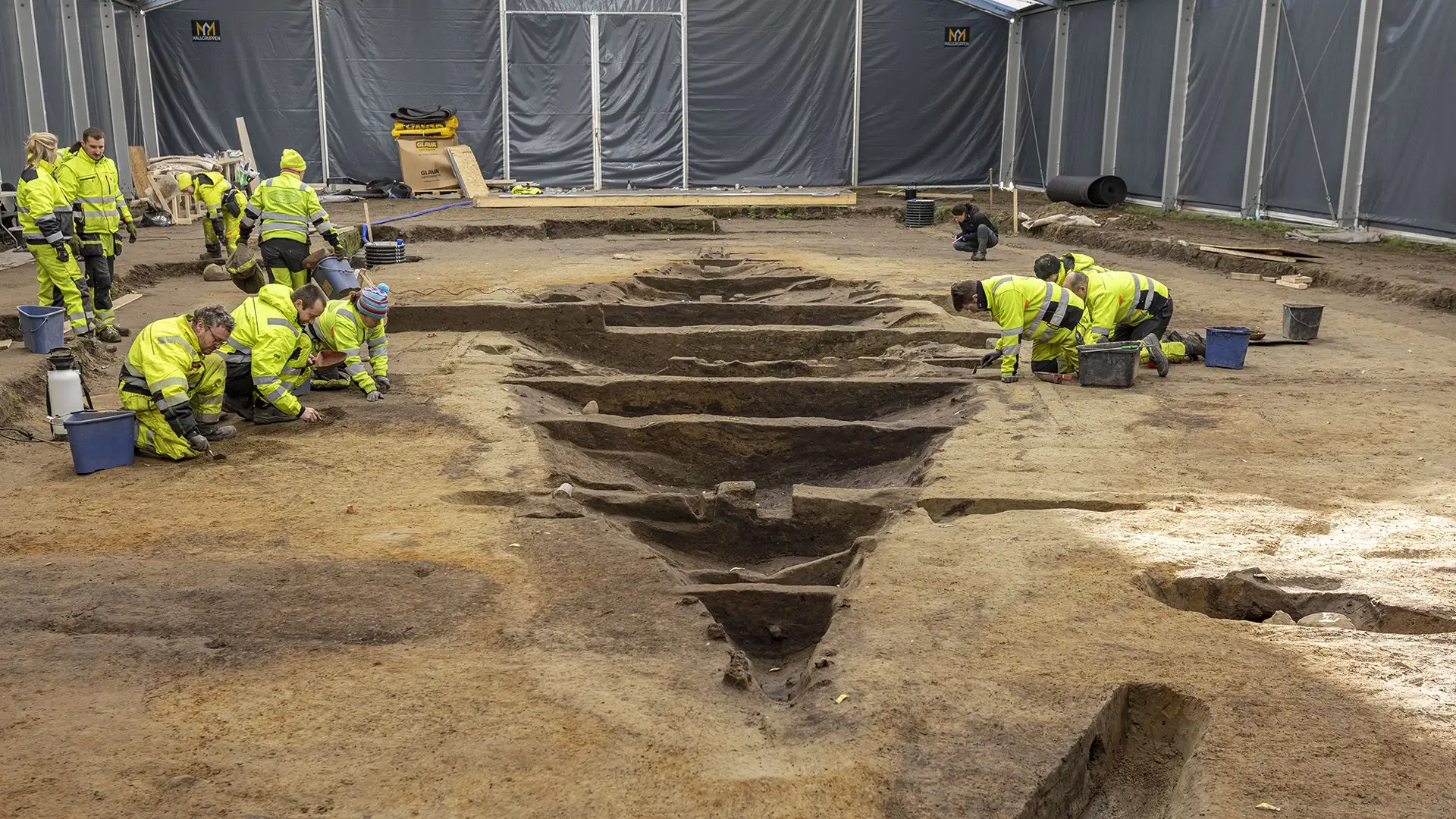
Toward the end of the Viking Age, a person who must have held a very special status in life was buried in Setesdal, southern Norway. His grave was discovered during an archaeological excavation carried out in connection with upgrades to the Norwegian national road at Bygland in Setesdal in 2011.
Christian symbols in pre-Christian grave
Originally, Grave 8 at the Langeid burial ground was probably covered by a “death house”, and the deceased lay in a wooden coffin that has long since decayed.
Outside the coffin lay what would become known as the Langeid sword, alongside a broad axe with a brass-covered shaft, a large piece of pitch pine, and two tiny fragments of broken silver coins.
An Anglo-Saxon silver penny minted during the reign of King Æthelred II of England, between 978 and 1016, dates the grave to the first half of the 11th century. This was a transitional period between the pre-Christian and Christian eras, when old beliefs and traditions were being challenged by new ideas and worldviews.
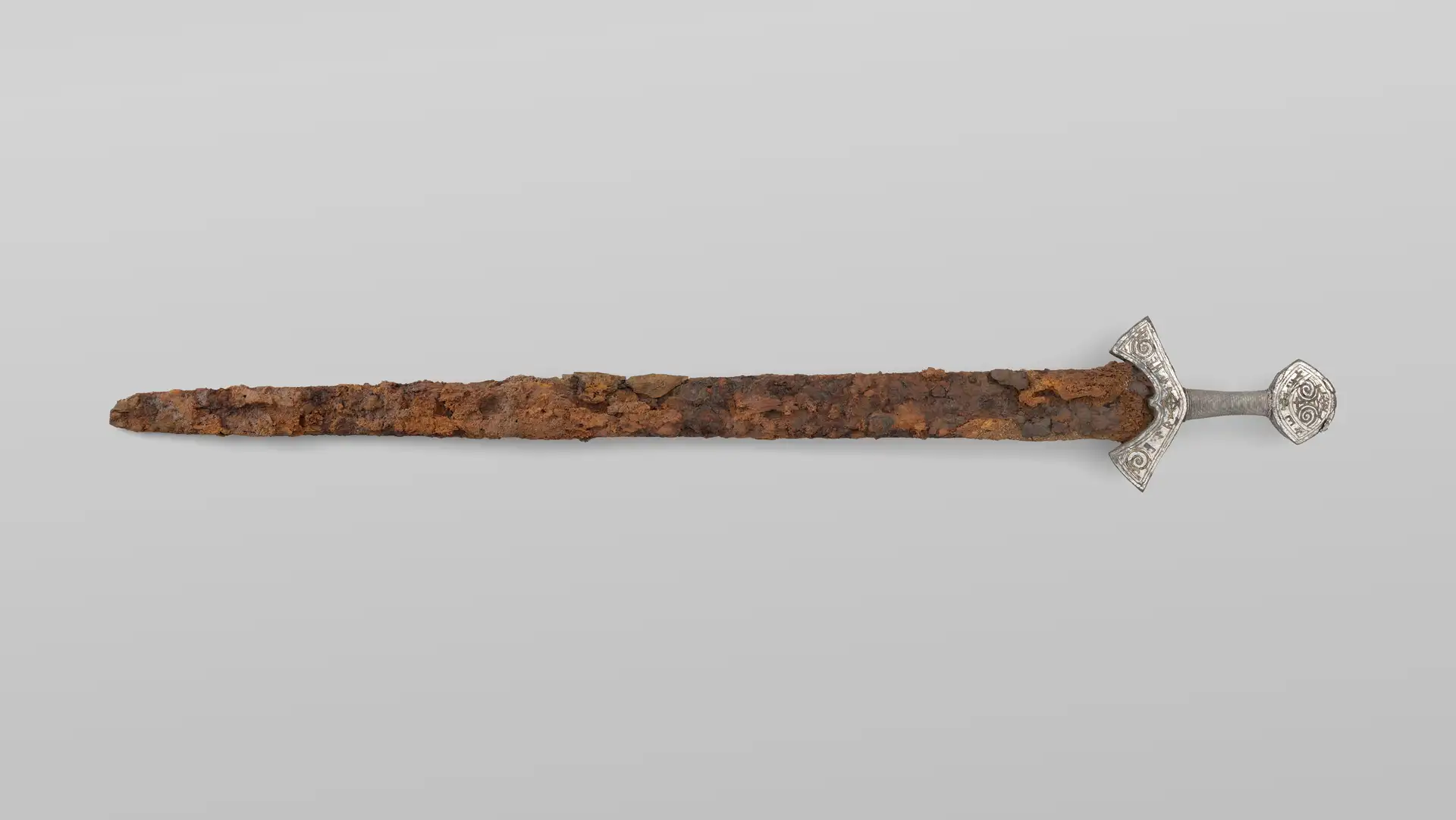
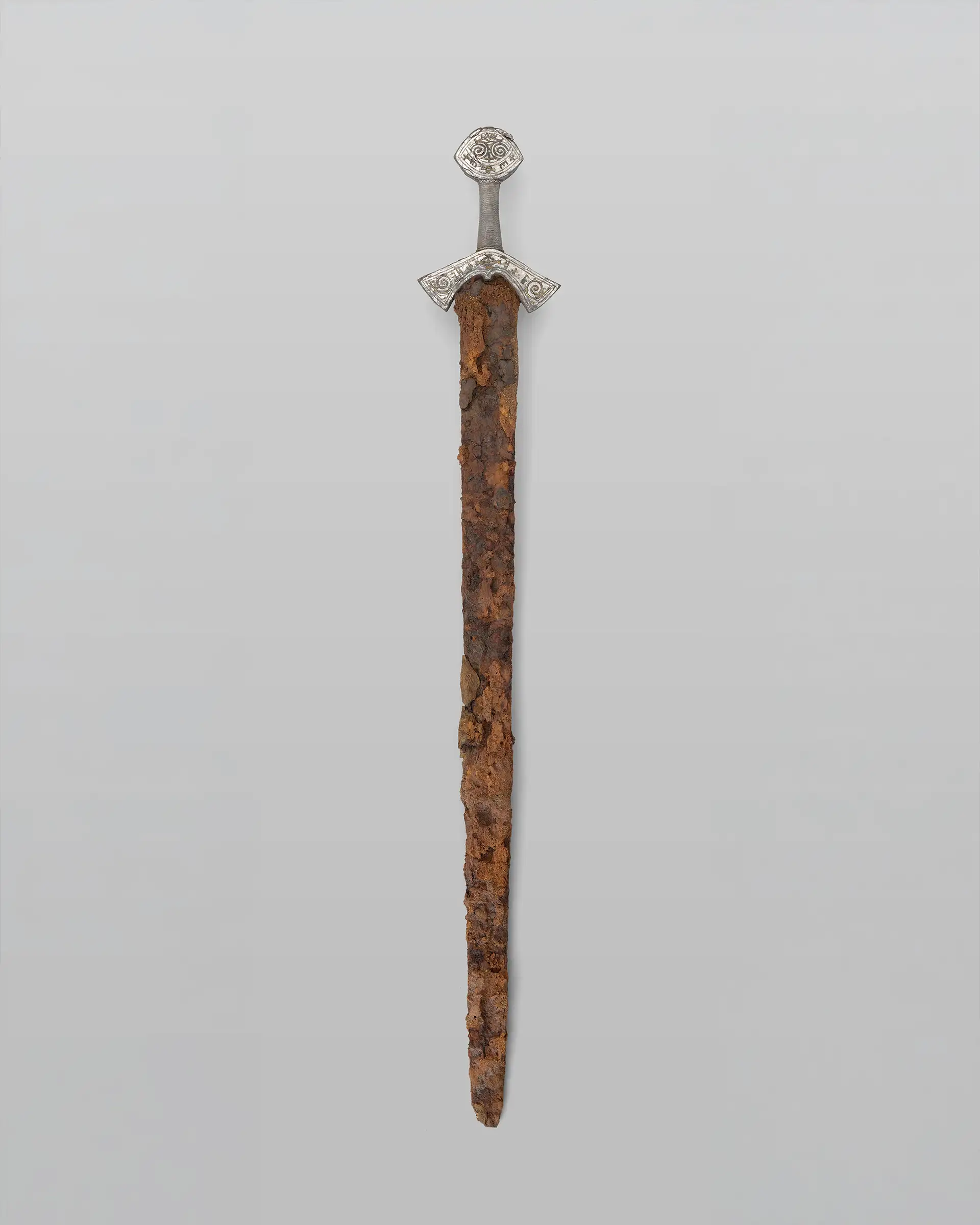
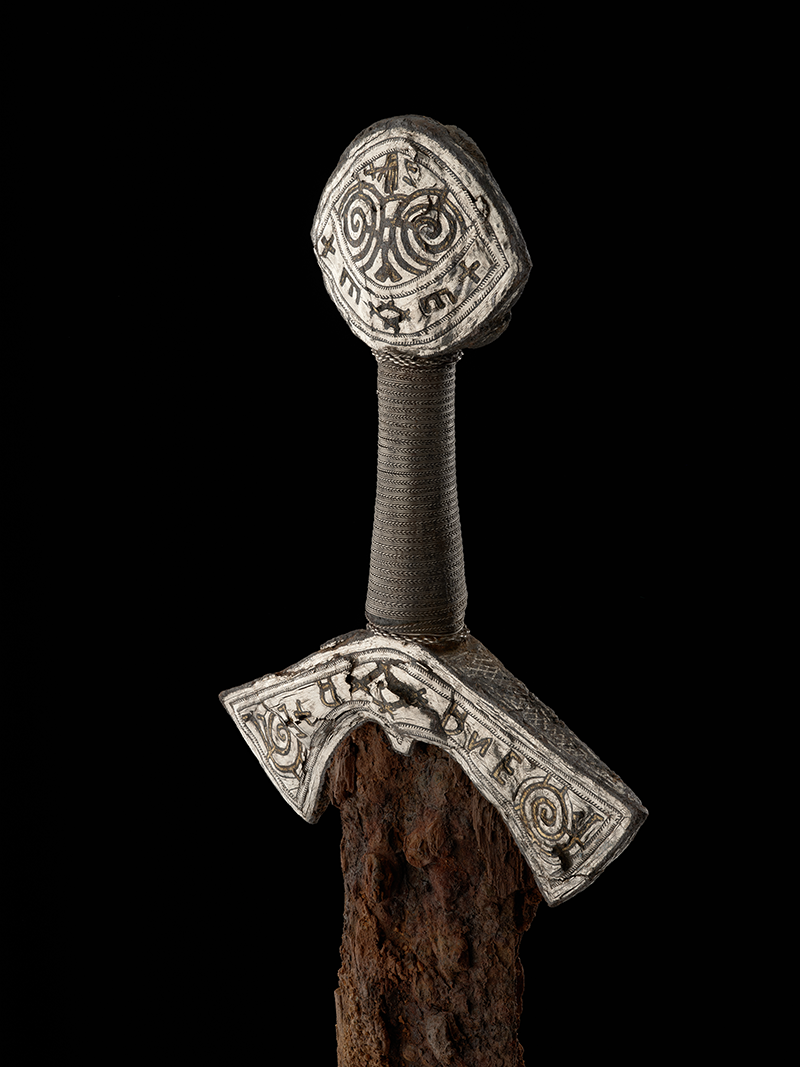
In many ways, the Langeid sword reflects this very dynamic: a Viking weapon imbued with Christian symbolism, found in a pre-Christian grave.
A golden hand to hold
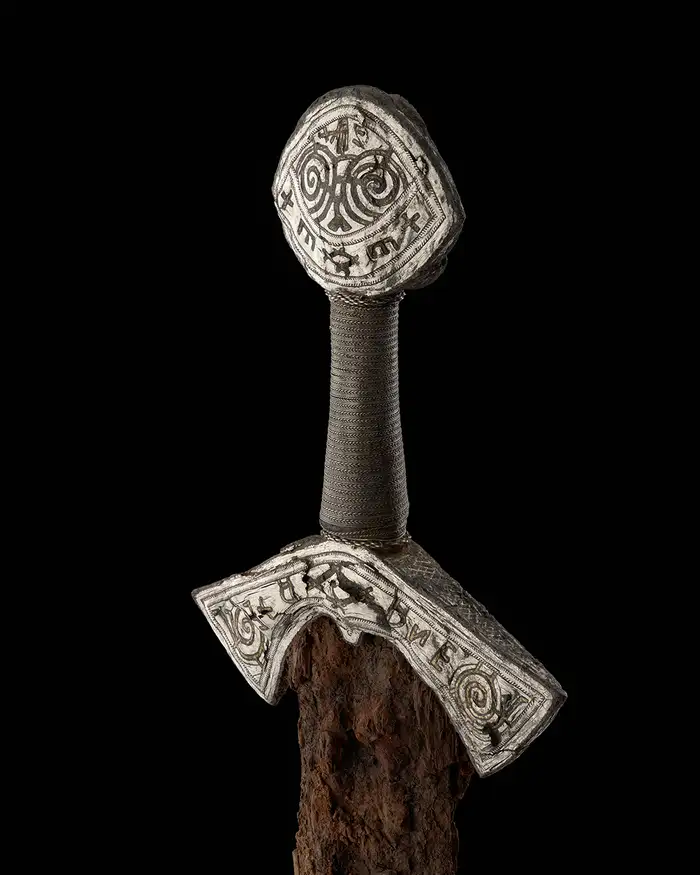
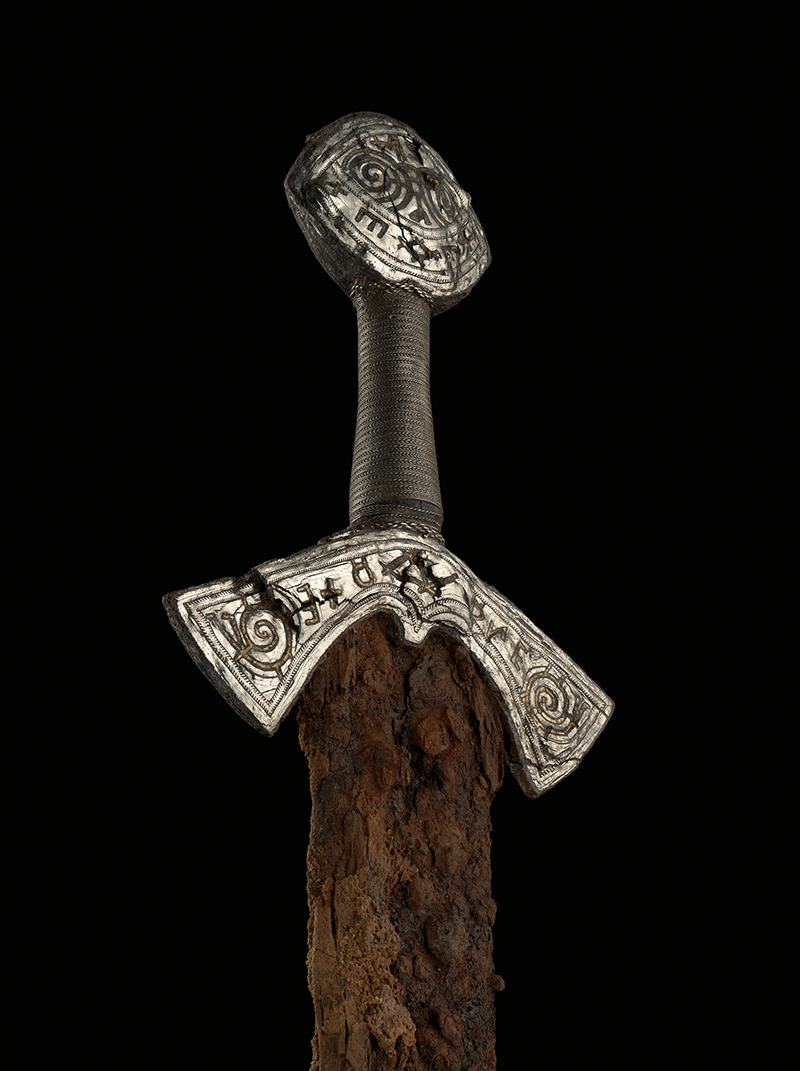
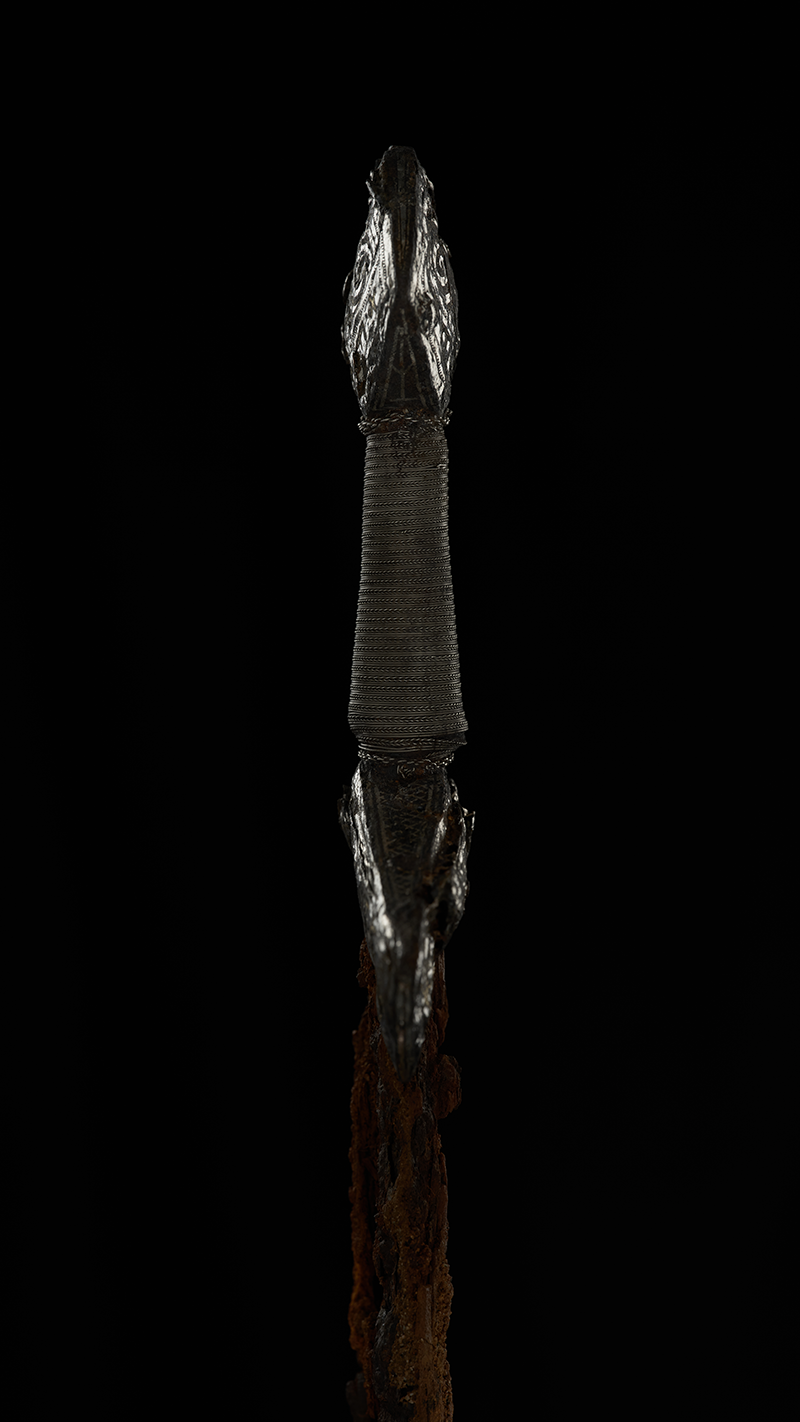
Letters and symbols are inlaid on the sword hilt using fine gold, copper, and silver wire. The wires were hammered into grooves cut into the iron. Alternating twisted and straight silver wires decorate the grip itself. It is a luxurious sword that would have been costly and time-consuming to produce.
At the top of the pommel, we see a unique feature: an open hand in gold, accompanied by a cross. Next to the hand is a stylized letter 'S'. This combination may be interpreted as a possible Xristos Salvator, a Greco-Latin Christian symbol representing Jesus as the Savior of humanity.
In terms of its shape, the sword corresponds to Jan Petersen’s Type Æ, featuring a down-curved lower guard. At 6.5 cm in length, the grip is one of the shortest known examples we know of.
Blade with symbols
Mysterious characters appear in several places on both the upper and lower guards, resembling a blend of Old Norse runes and Latin letters.
On the sword blade, traces of wood can be seen, now concealed within the rusted iron. These are remnants of the scabbard that held the sword when it was not in use. X-ray imaging reveals that the blade itself also holds symbols or an inscription.
The sword thus conceals additional secrets that may eventually be brought to light.
Who was the owner of the Langeid sword?
Who was this person buried with such a magnificent sword? In the Viking Age, the sword was a weapon in the truest sense, a symbol of the warrior elite.
In Norse sagas, we read of great men wielding gold-adorned weapons, such as hjölt ór gulli (hilt of gold) or gullbúin (gold-covered/gold-bound). The Saga of Saint Olaf says:
The king gave him a sword which had its grip wrapped in gold and a gold-covered hilt.
In the Langeid grave, we find not just one, but two exceptional weapons. Brass-shaftet broadaxes have been linked to Cnut the Great’s force of housecarls, known as Tingliden. Cnut was King of England from 1016 to 1035 and inherited the Danish throne in 1018. In 1028, he was recognized as the overlord of Norway.
It is quite tempting to picture a man from Setesdal serving in Cnut’s personal bodyguard.