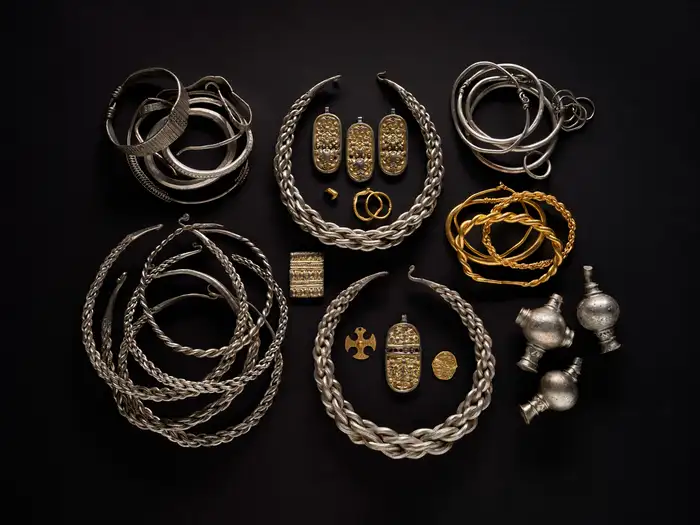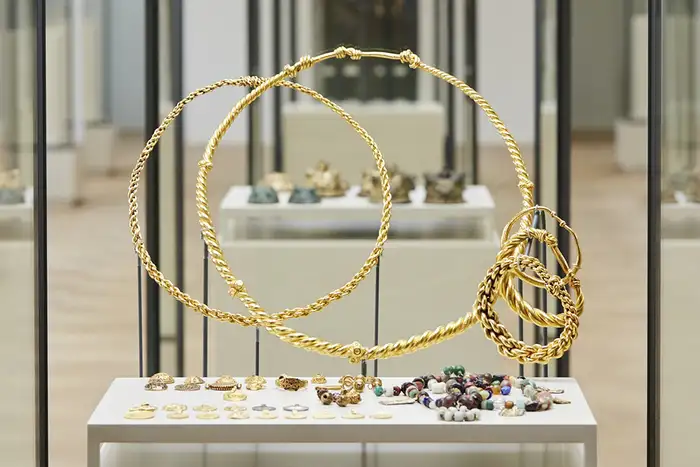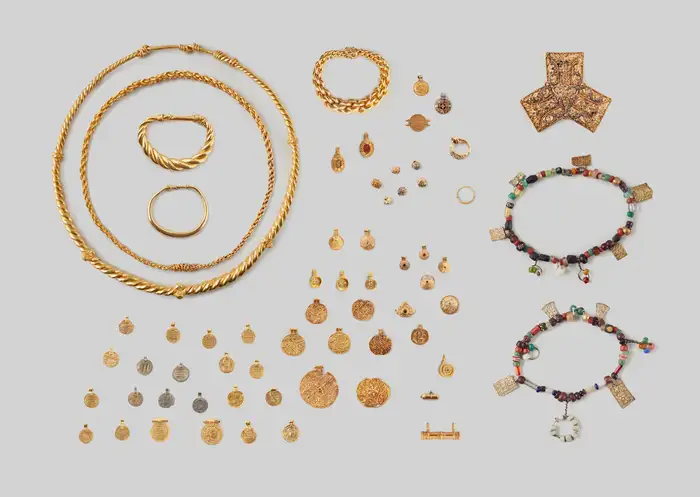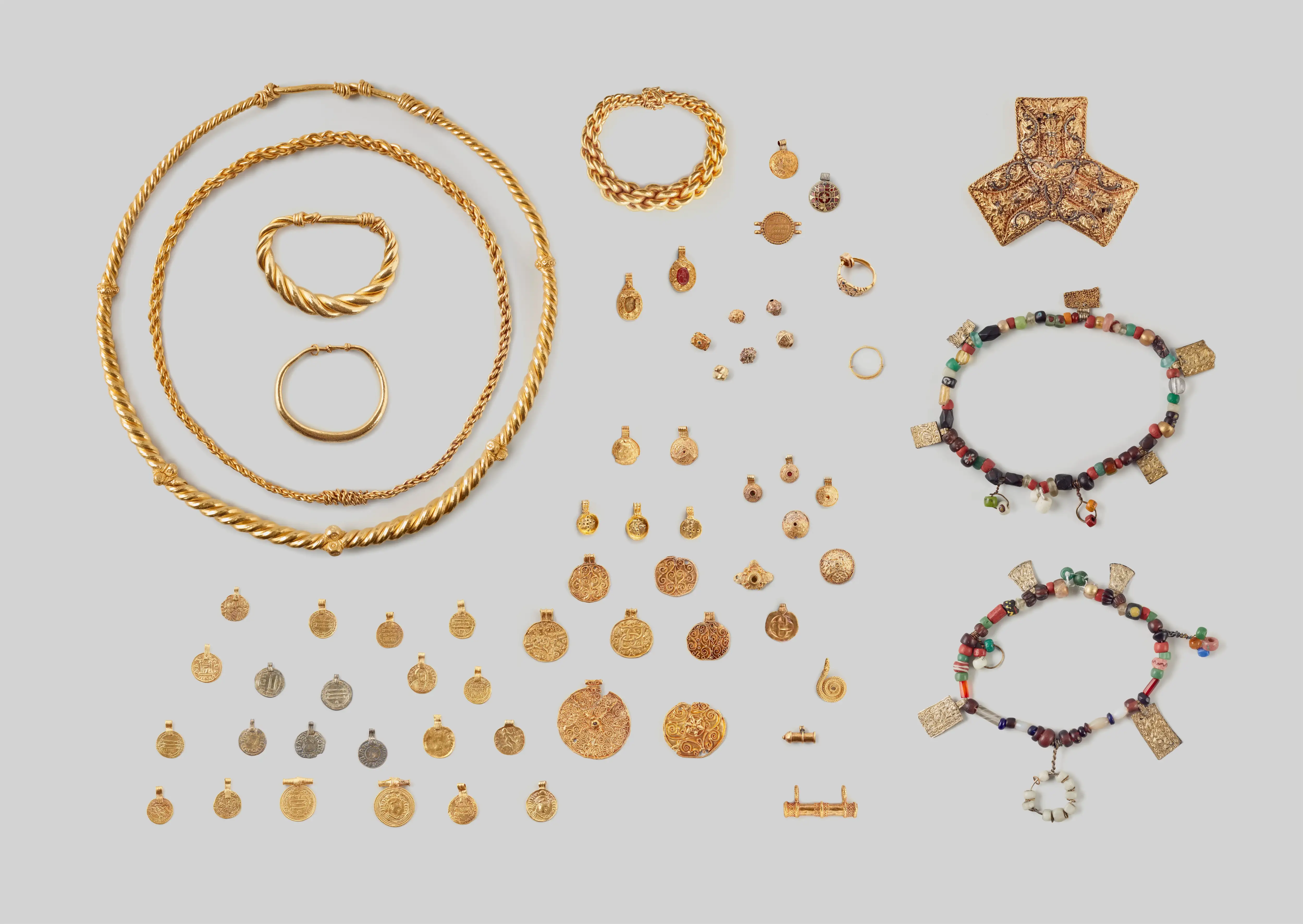
The largest objects in the hoard are two massive neck rings and three arm rings, all in gold, likely made in Scandinavia. Gold symbolised the aristocracy and was likely regarded by the Vikings as the metal of the gods.
Five filigree-decorated gold foil, which have been converted into medallions, originate from areas in present-day France, Germany, and Northern Italy. The goldsmith was likely inspired by the vines and scrolls of richly decorated Carolingian manuscripts.
A genuine antiquity from the Roman Empire! A gold-foil pendant holds an intaglio of red carnelian, a reddish-yellow stone not naturally found in Scandinavia.
It is not easy to discern today, but it depicts a satyr holding a wanderer's staff, a pedum, in one hand and a bunch of grapes in the other. Such intaglios generally date to the 3rd century. The surrounding gold is of later Carolingian work.
A link from a chain, bearing the inscription "Lord, help your servant John" in Greek letters and originating from Byzantium (modern-day Istanbul), can be dated to the years 850–880.
In the 10th century, the Byzantine Empire experienced a new golden age that attracted merchants and mercenaries from Scandinavia, the so-called Varangians.
A royal ring from England? Decorated in the English Trewhiddle style of the 9th century, similar gold rings were used by King Æthelwulf of Wessex (839–858) and his daughter Æthelswith, Queen of Mercia (853–887).
The Carolingian strap divider in the Hoen Hoard is the largest in the world and the only one made of solid gold. It is lavishly decorated with acanthus motifs coated with niello.
Originally from the region spanning France, Germany, and northern Italy, it was made as a fitting for a weapons belt. A pin on the reverse shows that the Vikings later repurposed it as a piece of jewellery before it was buried in the bog with the rest of the hoard.
This type of repurposing paved the way for an entirely new jewellery trend in the Viking Age: trefoil brooches, which are found in Norse women’s graves. Weapon fittings were transformed into women’s jewellery.
Broken silver fittings converted into pendants. Here, we see the Scandinavian gripping beast surrounded by decorative borders featuring knotwork and ribbon-like patterns.
These gripping beasts belong to one of the earliest variants of the Viking Age: the Salin style III and the Oseberg style.
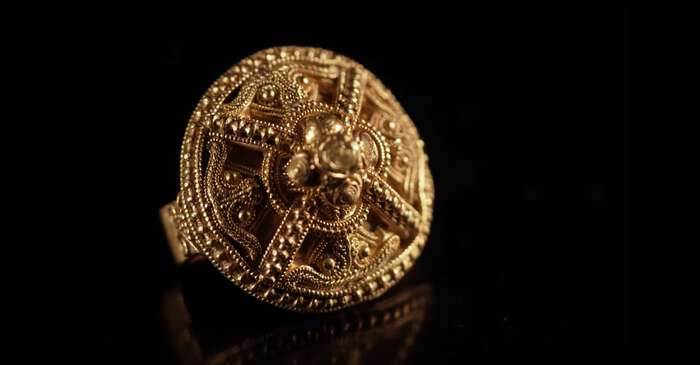
A medallion featuring cut inlays of red garnet, executed in the cloisonné technique. At the center is a symmetrical gold cross, and the medallion reflects Anglo-Saxon and Byzantine styles.
Luxurious beads from the Caucasus, Ukraine, India, Iran, France, the Czech Republic and Scandinavia. Some are made of gold, while others are gold-foiled.
Cobalt blue, violet and sea-green glass beads offer us glimpses of a colorful past. Agate and carnelian beads tell of Viking trade routes in the east.
Tubular cases like this originate from the Mediterranean region and have been found in graves in present-day Hungary and Greece. Perhaps they once held sacred relics or fragrant oils and perfumes.
Jörmungandr is the name of the Midgard Serpent; the sea serpent and ocean monster so vast, it encircles all of Midgard. The coiled serpent pendant is Scandinavian, and likely dates from the mid-Viking Age.
The hoard contains 20 coins, including Arab coins as well as coins from the Roman Empire, Istanbul, England and France. Four silver coins and 16 rare gold coins have all been made into pendants. The oldest is a Roman gold solidus minted by Emperor Valens in the period between the years 364 and 367.
Ten Islamic coins of gold and silver were minted in Baghdad, Egypt and Merv; several of them bear graffiti consisting of Old Norse runes or simple strokes. The most recent coin is Abbasid, minted under Al-Mutawakkil between the years 848 and 849.
The Hoen Hoard is the only one of its kind from the Viking Age in Norway, dating from a time when the economy was based on silver measured in units and weight. The gold hoard is a unique testament to power, politics and alliances in the Viking world.