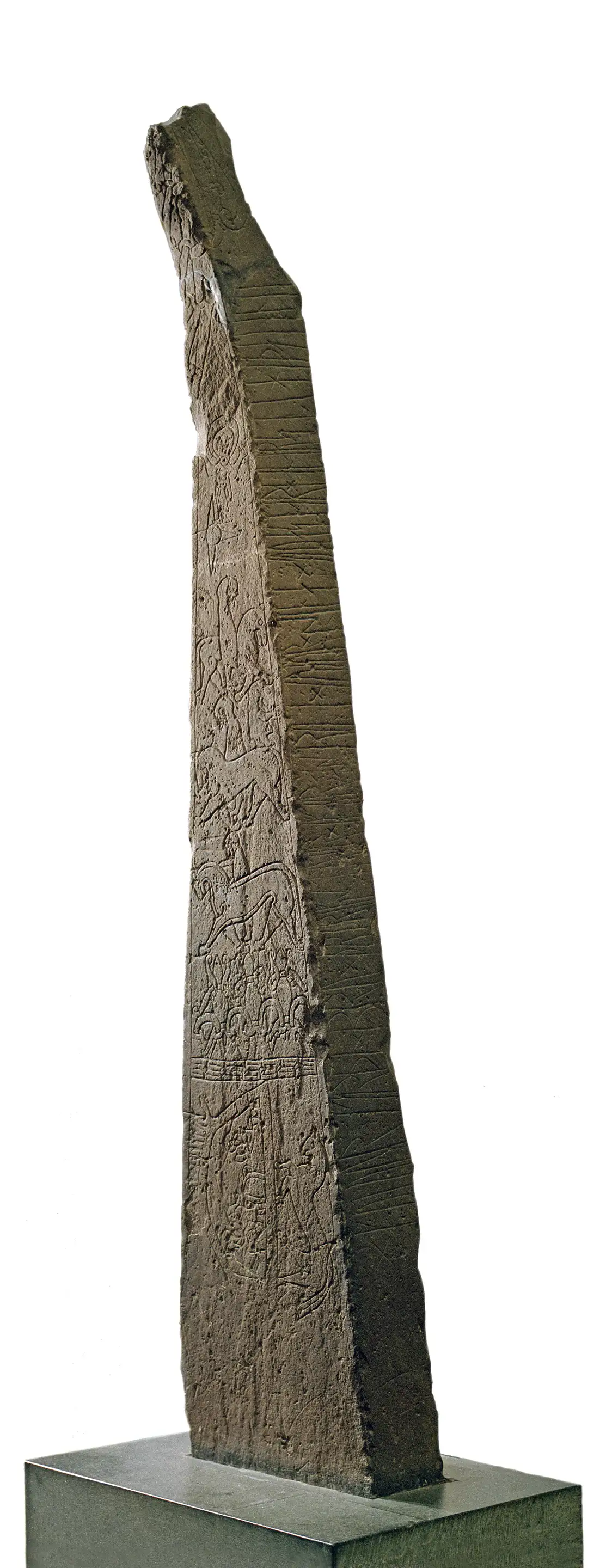
The Dynna Stone, dating from the middle of the 11th century, is truly unique.
The motifs are clearly Christian, yet the custom of raising runestones has deep roots in pre-Christian times.
The Christ Child
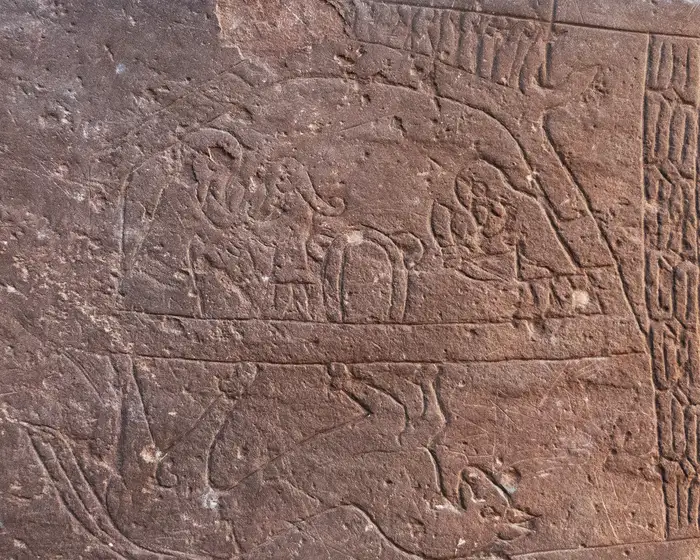
While the runes are carved along one of the stone's edges, one of the broad sides features carved motifs recognizable from the story of Jesus' birth in the New Testament in the Bible. The scene depicts the Three Wise Men following the Star of Bethlehem all the way to Mary and presenting her with gifts. The small figure at the top of the stone can be interpreted as either the newborn child Jesus or an angel.
Norway was Christianized over a long period, stretching from around year 850 well into the Norwegian High Middle Ages. In many places, old and new beliefs and traditions coexisted for a long time. The Dynna Stone is a clear testimony to this transition from paganism to Christianity in Norway.
The handiest maiden in Hadeland
The stone was found at Northern Dynna farm in Hadeland, Eastern Norway. Runic inscriptions often serve as memorials to the deceased, which is the case here as well. The fact that a woman erected the stone in memory of another woman, her daughter, also makes it special.
The runic inscription running up the edge reads:
Gunnvor Trydriksdatter made a bridge in memory of Astrid, her daughter. She was the handiest maiden in Hadeland.
It is easy to imagine that Gunnvor belonged to one of the first generations of Christians in what would become Norway. Astrid may have been buried in the Christian cemetery, but the stone erected in her memory stood at home, near the old burial mound on the farm.
This also shows that women played an active and visible role in the early Christianization of Norway.
What does it mean to "make a bridge"?
There are few examples of this in Norway, but references to bridge-building in runic inscriptions are quite common on Swedish runestones from this period. To "make a bridge" can hold both a practical and a symbolic meaning within the Christian faith: just as a physical bridge eases a journey, a symbolic bridge can facilitate the soul's passage from this world to the next.
The symbolic and mythological significance of a bridge was already known in Norse religion, where a bridge connected the world of the living with the world of the dead—Hel.
The Dynna Stone depicts three generations: the grandfather Trydrik, the mother Gunnvor, and the daughter Astrid. In this way, the stone also creates a metaphorical bridge between the generations. Its placement by the old burial mound on the farm also helps bridge the gap between Astrid and her lineage, as well as between the old era and the new.
Damaged
The stone is made of Ringerike sandstone and weighs around 400 kilograms.
Its top is damaged, and the surface is marked by holes and various other marks. Someone has even scratched their initials and the year 1875 into one of the motifs on the front.
Fun fact
The practice of carving runes dates back to the beginning of the Common Era and remained prevalent throughout the late Middle Ages.
The museum’s collection includes more than ten runestones from the Viking Age. Seven of them are on display at the Viking Age Museum.
There is a small hollow or depression on the back of the stone. This likely dates back to when the stone lay toppled on the ground; cows licked up so much of the stone's natural salt that they created an indentation.
The first time the Dynna Stone was mentioned in print was in Ole Worm’s major work on runic inscriptions from 1643.
There is also a colored drawing with a brief description from 1627 by Peder Alfssøn, which is now held in the Arnamagnæan Manuscript Collection in Copenhagen.
In the 18th century, the stone stood at the farm at Dynna. In the summer of 1879, a local doctor in Hadeland arranged for the stone to be added to the museum's collection.
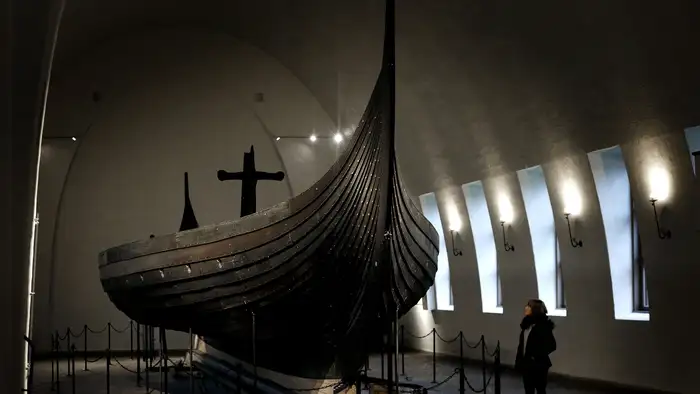
Since then, it has been exhibited several times at the Historical Museum, but now this extraordinary monument is getting a permanent home at the Museum of the Viking Age.